Manuela Cavaco
Seven photographs from one night at Fado ao Carmo, scrolling over the actual recording as it plays through. Turn the sound on in the corner, and give it a few quiet minutes.
Fado ao Carmo sits in Chiado, a short walk from the ruined nave of the Convento do Carmo — left roofless by the 1755 earthquake and still standing open to the sky above the square the house takes its name from.

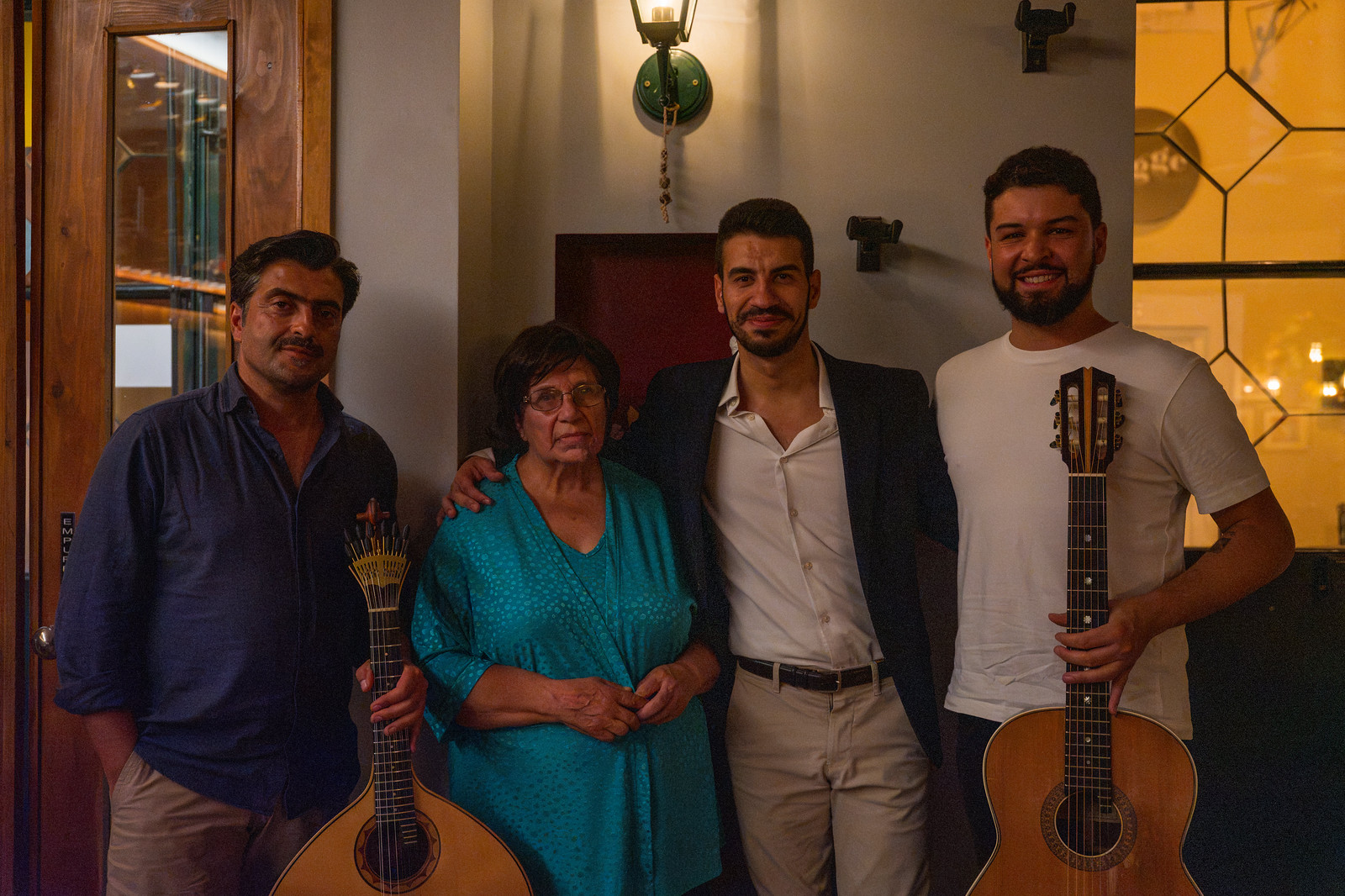
Manuela Cavaco is Capítulo IX's guest singer, taking the floor at Fado ao Carmo for a night of fado in the heart of Chiado.

The song is "Maldição," set to the traditional Fado Bacalhau — words by Fernando Farinha, one of fado's own great mid-century voices, credited here as poet rather than singer, with music by José António da Silva.

Luís Guerreiro returns on guitarra portuguesa — a permanent member of Mariza's band since 2003 and a resident guitarrista at Fado ao Carmo itself, first seen in this series back in Capítulo VII.

Flávio César Cardoso takes guitarra acústica for the night, the two guitars carrying "Maldição" the way Fado Bacalhau has carried a hundred different sets of words before it.

Recorded on the 30th of August 2026 — Chiado's shopfronts and theatres a few streets over, and none of it audible from inside this room.

The last frame of the night — one more room added to a series that keeps finding them, one voice at a time.
Manuela Cavaco
Manuela Cavaco was born in 1943 in Montijo, in a fishing neighbourhood where the men sang while they worked, and grew up singing along to fados she learned off the radio while working as a seamstress. She might never have turned professional at all if her son — a member of a local choral group — hadn't talked her into performing at a Montijo municipal event; the invitations that followed never really stopped.
She spent roughly three years singing at the Número 1 restaurant, four more at Taverna do Embuçado, and later at Forte D. Rodrigo, building toward stages like the Teatro Maria Matos, the Centro Cultural de Belém and the Casino Estoril, and touring for Portuguese communities as far as the United States and Argentina. More than eighty fados into a recording career that includes three albums for Discoteca Amália, she still names Amália Rodrigues and Maria Teresa de Noronha as the two voices that shaped her own.
Fado ao Carmo, Chiado
This is the other half of Fado ao Carmo's two-house operation — the Chiado room, on Rua da Condessa beside Largo do Carmo, in the part of Lisbon that's long belonged to writers, theatre people and the literary cafés they used to argue in. Its sister house sits across town in Alfama, in the neighbourhood where fado actually began.
Chiado's version of the tradition runs on the same principle both houses share: dinner and fado together, no separation between the two, and a Portuguese guitar doing exactly what it's done since fado first let it in, sometime after 1840 — filling the silence between one line and the next.
What shot and recorded this session.
- Audio
- 2× 34mm large-diaphragm condenser microphones
- 1× Sennheiser MKE600 shotgun microphone
- 1× Zoom H6 Essential recorder
- 1× Andoer handheld microphone boom arm
- Video
- 1× Lumix S1RII body with Lumix S 50mm f/1.8
- 1× Lumix S5IIX with Sigma 35mm f/1.4 DG DN Art (L-mount)
- 1× Lumix S5D body with Lumix S 20-60mm f/3.5-5.6
- 1× DJI Osmo Pocket 3
- 1× VILTROX DC-550 field monitor
- 1× Osee G7 Pro 7-inch field monitor
- Grip
- 1× Falcon Eyes CVT-20 tripod + Falcon Eyes VF-7.5 fluid video head
- 1× Cayer BV30L/K3 72-inch video tripod system
- 1× K&F 200cm tripod / K234A7
- 1× Neewer 300cm light stand
Seven frames from a fado house tucked behind Chiado's ruined convent.
Photographed and recorded by Luis Roquette Valdez, Fado ao Carmo, Chiado, Lisbon, 30 August 2026.